Label: TNKASE- tenecteplase kit

-
NDC Code(s):
50242-009-01,
50242-014-03,
50242-037-06,
50242-176-01, view more50242-901-09, 50242-907-01
- Packager: Genentech, Inc.
- Category: HUMAN PRESCRIPTION DRUG LABEL
- DEA Schedule: None
- Marketing Status: Biologic Licensing Application
Drug Label Information
Updated December 15, 2025
If you are a consumer or patient please visit this version.
- Download DRUG LABEL INFO: PDF XML
- Official Label (Printer Friendly)
-
HIGHLIGHTS OF PRESCRIBING INFORMATION
These highlights do not include all the information needed to use TNKASE safely and effectively. See full prescribing information for TNKASE.
TNKase® (tenecteplase) for injection, for intravenous use
Initial U.S. Approval: 2000RECENT MAJOR CHANGES
INDICATIONS AND USAGE
DOSAGE AND ADMINISTRATION
DOSAGE FORMS AND STRENGTHS
For Injection: 25 mg or 50 mg lyophilized powder in a single-dose vial co-packaged with Sterile Water for Injection USP (diluent). (3)
CONTRAINDICATIONS
-
AIS and STEMI
- Active internal bleeding (4)
- Intracranial or intraspinal surgery or trauma within 2 months (4)
- Known bleeding diathesis (4)
- Current severe uncontrolled hypertension (4)
- Presence of intracranial conditions that may increase the risk of bleeding (e.g., intracranial neoplasm, arteriovenous malformation, or aneurysm) (4)
-
AIS
- Active intracranial hemorrhage (4)
-
Acute STEMI
- History of intracranial hemorrhage
- History of ischemic stroke within 3 months (4)
WARNINGS AND PRECAUTIONS
- Bleeding: Increases the risk of bleeding. Avoid intramuscular injections. Monitor for bleeding. (5.1)
- Hypersensitivity: Monitor patients treated with TNKase during and for several hours after administration. If symptoms of hypersensitivity occur, initiate appropriate therapy (e.g., antihistamines, corticosteroids, epinephrine). (5.2)
- Thromboembolism: The use of thrombolytics can increase the risk of thrombo-embolic events in patients with high likelihood of left heart thrombus. (5.3)
- Cholesterol Embolization: Has been reported in patients treated with thrombolytic agents. (5.4)
- Arrhythmias: It is recommended that anti-arrhythmic therapy for bradycardia and/or ventricular irritability be available when TNKase is administered. (5.5)
- Increased Risk of Heart Failure and Recurrent Ischemia when used with Planned Percutaneous Coronary Intervention in STEMI: In patients with a large ST segment elevation myocardial infarction, choose either thrombolysis or PCI as the primary treatment for reperfusion. Rescue PCI or subsequent elective PCI may be performed after administration of thrombolytic therapies if medically appropriate. (5.6)
ADVERSE REACTIONS
The most common adverse reaction is bleeding. (6)
To report SUSPECTED ADVERSE REACTIONS, contact Genentech at 1-888-835-2555 or FDA at 1-800-FDA-1088 or www.fda.gov/medwatch.
DRUG INTERACTIONS
During TNKase therapy, results of coagulation tests and/or measures of fibrinolytic activity may be unreliable unless specific precautions are taken to prevent in vitro artifacts. (7.1)
See 17 for PATIENT COUNSELING INFORMATION.
Revised: 2/2025
-
AIS and STEMI
-
Table of Contents
FULL PRESCRIBING INFORMATION: CONTENTS*
1 INDICATIONS AND USAGE
1.1 Acute Ischemic Stroke
1.2 Acute ST Elevation Myocardial Infarction
2 DOSAGE AND ADMINISTRATION
2.1 Recommended Dosage for Acute Ischemic Stroke
2.2 Recommended Dosage for Acute ST Elevation Myocardial Infarction
2.3 Preparation
2.4 Administration
2.5 Chemical Incompatibilities
3 DOSAGE FORMS AND STRENGTHS
4 CONTRAINDICATIONS
5 WARNINGS AND PRECAUTIONS
5.1 Bleeding
5.2 Hypersensitivity
5.3 Thromboembolism
5.4 Cholesterol Embolization
5.5 Arrhythmias
5.6 Increased Risk of Heart Failure and Recurrent Ischemia when used with Planned Percutaneous Coronary Intervention (PCI) in STEMI
6 ADVERSE REACTIONS
6.1 Clinical Trials Experience
7 DRUG INTERACTIONS
7.1 Drug/Laboratory Test Interactions
8 USE IN SPECIFIC POPULATIONS
8.1 Pregnancy
8.2 Lactation
8.4 Pediatric Use
8.5 Geriatric Use
11 DESCRIPTION
12 CLINICAL PHARMACOLOGY
12.1 Mechanism of Action
12.2 Pharmacodynamics
12.3 Pharmacokinetics
12.6 Immunogenicity
13 NONCLINICAL TOXICOLOGY
13.1 Carcinogenesis, Mutagenesis, Impairment of Fertility
14 CLINICAL STUDIES
14.1 Acute Ischemic Stroke
14.2 Acute ST Elevation Myocardial Infarction
16 HOW SUPPLIED/STORAGE AND HANDLING
16.1 How Supplied
16.2 Storage and Handling
17 PATIENT COUNSELING INFORMATION
- *
- Sections or subsections omitted from the full prescribing information are not listed.
- 1 INDICATIONS AND USAGE
-
2 DOSAGE AND ADMINISTRATION
2.1 Recommended Dosage for Acute Ischemic Stroke
Initiate treatment as soon as possible and within 3 hours after the onset of stroke symptoms.
TNKase is for intravenous (IV) administration only, administered as a single bolus over 5 seconds. Individualize dosage based on the patient's weight (see Table 1). The maximum recommended dose is 25 mg (5 mL).
Table 1 Recommended Dosage for Acute Ischemic Stroke Patient Weight
(kg)TNKase
(mg)Volume TNKase to be administered (mL) less than 60 kg 15 mg 3 mL 60 kg to less than 70 kg 17.5 mg 3.5 mL 70 kg to less than 80 kg 20 mg 4 mL 80 kg to less than 90 kg 22.5 mg 4.5 mL 90 kg or more 25 mg 5 mL During and following TNKase administration for the treatment of acute ischemic stroke, frequently monitor and control blood pressure.
In patients without recent use of oral anticoagulants or heparin, TNKase treatment can be initiated prior to the availability of coagulation study results. If the pretreatment International Normalized Ratio (INR) is greater than 1.7 or the activated partial thromboplastin time (aPTT) is elevated, closely monitor patients [see Contraindications (4)].
2.2 Recommended Dosage for Acute ST Elevation Myocardial Infarction
Initiate treatment as soon as possible after the onset of STEMI symptoms.
TNKase is for intravenous (IV) administration only, administered as a single bolus over 5 seconds. Individualize dosage based on the patient's weight (see Table 2). The maximum recommended dose is 50 mg (10 mL).
Table 2 Recommended Dosage for Acute ST Elevation Myocardial Infarction Patient Weight
(kg)TNKase
(mg)Volume TNKase to be administered (mL) less than 60 kg 30 mg 6 mL 60 kg to less than 70 kg 35 mg 7 mL 70 kg to less than 80 kg 40 mg 8 mL 80 kg to less than 90 kg 45 mg 9 mL 90 kg or more 50 mg 10 mL 2.3 Preparation
Follow the steps below to prepare TNKase for administration:
- Only use the supplied Sterile Water for Injection diluent vial for reconstitution as shown below.
TNKase Vial Strength Sterile Water for Injection Vial Volume 25 mg 5.2 mL 50 mg 10 mL - Using a sterile syringe, aseptically withdraw the Sterile Water for Injection from the diluent vial and reconstitute the TNKase vial by directing the stream into the lyophilized powder to obtain a final concentration of 5 mg/mL. Slight foaming upon reconstitution is not unusual; any large bubbles will dissipate if the product is allowed to stand undisturbed for several minutes.
- Gently swirl until contents are completely dissolved. DO NOT SHAKE. The reconstituted preparation results in a colorless to pale yellow transparent solution.
- Determine the appropriate dose of TNKase [see Dosage and Administration (2.1, 2.2)] and withdraw the required volume (in milliliters) from the reconstituted vial into the syringe. Discard any unused solution.
2.4 Administration
Follow the steps below for administration of TNKase:
- Visually inspect the reconstituted product in the syringe for particulate matter and discoloration prior to administration.
- Precipitation may occur when TNKase is administered in an intravenous line containing dextrose. Flush dextrose-containing lines with 0.9% Sodium Chloride Injection solution prior to and following single bolus administration of TNKase.
- Using sterile technique, connect the syringe directly to the intravenous port.
- Administer reconstituted TNKase as a single intravenous bolus over 5 seconds.
- Because TNKase contains no antibacterial preservatives, reconstitute immediately before use. If the reconstituted TNKase is not used immediately, refrigerate the TNKase vial at 2°C to 8°C (36°F to 46°F) and use within 8 hours.
- Dispose of the syringe per established procedures.
- 3 DOSAGE FORMS AND STRENGTHS
-
4 CONTRAINDICATIONS
AIS and Acute STEMI
TNKase is contraindicated in any patients with:
- Active internal bleeding
- Intracranial or intraspinal surgery or trauma within 2 months
- Known bleeding diathesis
- Current severe uncontrolled hypertension
- Presence of intracranial conditions that may increase the risk of bleeding (e.g., intracranial neoplasm, arteriovenous malformation, or aneurysm)
-
5 WARNINGS AND PRECAUTIONS
5.1 Bleeding
TNKase can cause significant, sometimes fatal, internal or external bleeding, especially at arterial and venous puncture sites. Concomitant use of other drugs that impair hemostasis increases the risk of bleeding. Avoid intramuscular injections and trauma to the patient while on TNKase. Perform arterial and venous punctures carefully and only as required. To minimize bleeding from noncompressible sites, avoid internal jugular and subclavian venous punctures. If an arterial puncture is necessary during TNKase administration, use an upper extremity vessel that is accessible to manual compression, apply pressure for at least 30 minutes, and monitor the puncture site closely.
Should serious bleeding that is not controlled by local pressure occur, discontinue any concomitant heparin or antiplatelet agents immediately and treat appropriately. Because of the higher risk of intracranial hemorrhage in patients treated for acute ischemic stroke, limit treatment to facilities that can provide timely access to appropriate evaluation and management of intracranial hemorrhage.
Aspirin and heparin have been administered concomitantly with and following administration of TNKase in the management of acute myocardial infarction, but the concomitant administration of heparin and aspirin with and following administration of TNKase for the treatment of acute ischemic stroke during the first 24 hours after symptom onset has not been investigated. Because heparin, aspirin, or TNKase may cause bleeding complications, carefully monitor for bleeding, especially at arterial puncture sites. Hemorrhage can occur 1 or more days after administration of TNKase, while patients are still receiving anticoagulant therapy.
If serious bleeding occurs, treat appropriately. In the following conditions, the risks of bleeding with TNKase therapy for all approved indications are increased and should be weighed against the anticipated benefits:
- Recent major surgery or procedure (e.g., coronary artery bypass graft, obstetrical delivery, organ biopsy, previous puncture of noncompressible vessels)
- Cerebrovascular disease
- Recent intracranial hemorrhage (if not contraindicated)
- Recent gastrointestinal or genitourinary bleeding
- Recent trauma
- Hypertension: systolic BP above 175 mm Hg or diastolic BP above 110 mm Hg
- Acute pericarditis
- Subacute bacterial endocarditis
- Hemostatic defects including those secondary to severe hepatic or renal disease
- Significant hepatic dysfunction
- Pregnancy
- Diabetic hemorrhagic retinopathy, or other hemorrhagic ophthalmic conditions
- Septic thrombophlebitis or occluded AV cannula at seriously infected site
- Advanced age [see Use in Specific Populations (8.5)]
- Patients currently receiving anticoagulants (e.g., warfarin sodium)
Any other condition in which bleeding constitutes a significant hazard or would be particularly difficult to manage because of its location.
5.2 Hypersensitivity
Hypersensitivity, including urticarial / anaphylactic reactions, have been reported after administration of TNKase (e.g., anaphylaxis, angioedema, laryngeal edema, rash, and urticaria). Monitor patients treated with TNKase during and for several hours after administration. If symptoms of hypersensitivity occur, initiate appropriate therapy (e.g., antihistamines, corticosteroids, epinephrine).
5.3 Thromboembolism
The use of thrombolytics can increase the risk of thrombo-embolic events in patients with high likelihood of left heart thrombus, such as patients with mitral stenosis or atrial fibrillation.
5.4 Cholesterol Embolization
Cholesterol embolism has been reported in patients treated with thrombolytic agents. Investigate cause of any new embolic event and treat appropriately.
5.5 Arrhythmias
Coronary thrombolysis may result in arrhythmias associated with reperfusion. These arrhythmias (such as sinus bradycardia, accelerated idioventricular rhythm, ventricular premature depolarizations, ventricular tachycardia) may be managed with standard anti-arrhythmic measures. It is recommended that anti-arrhythmic therapy for bradycardia and/or ventricular irritability be available when TNKase is administered.
5.6 Increased Risk of Heart Failure and Recurrent Ischemia when used with Planned Percutaneous Coronary Intervention (PCI) in STEMI
In a trial of patients with STEMI, there were worse outcomes in the individual components of the primary endpoint between TNKase plus PCI versus PCI alone (mortality 6.7% vs. 4.9%, respectively; cardiogenic shock 6.3% vs. 4.8%, respectively; and CHF 12% vs. 9.2%, respectively). In addition, there were worse outcomes in recurrent MI (6.1% vs. 3.7%, respectively; p = 0.03) and repeat target vessel revascularization (6.6% vs. 3.4%, respectively; p = 0.0045) in patients receiving TNKase plus PCI versus PCI alone [see Clinical Studies (14.2)]. In patients with large ST segment elevation myocardial infarction, physicians should choose either thrombolysis or PCI as the primary treatment strategy for reperfusion. Rescue PCI or subsequent elective PCI may be performed after administration of thrombolytic therapies if medically appropriate; however, the optimal use of adjunctive antithrombotic and antiplatelet therapies in this setting is unknown.
-
6 ADVERSE REACTIONS
The following clinically significant adverse reactions are discussed in other sections of the label:
- Bleeding [see Contraindications (4), Warnings and Precautions (5.1)]
- Hypersensitivity [see Warnings and Precautions (5.2)]
- Thromboembolism [see Warnings and Precautions (5.3)]
- Cholesterol Embolization [see Warnings and Precautions (5.4)]
- Arrhythmias [see Warnings and Precautions (5.5)]
- Increased Risk of Heart Failure and Recurrent Ischemia when used with Planned Percutaneous Coronary Intervention (PCI) in STEMI [see Warnings and Precautions (5.6)]
6.1 Clinical Trials Experience
Because clinical trials are conducted under widely varying conditions, adverse reaction rates observed in the clinical trials of a drug cannot be directly compared to rates in the clinical trials of another drug and may not reflect the rates observed in practice.
The most frequent adverse reaction associated with TNKase in all approved indications is bleeding.
Acute Ischemic Stroke
In Trial 1, the safety of TNKase for the treatment of acute ischemic stroke (AIS) was evaluated in 592 patients who received TNKase at the recommended dosage within 0 to 3 hours of the onset of stroke symptoms (Alteplase compared to Tenecteplase (AcT); Trial 1) [see Dosage and Administration (2.1) and Clinical Studies (14.1)].
Table 3 describes the incidence of adverse reactions in patients with AIS in Trial 1.
Table 3 Incidence of Adverse Reactions in Trial 1 in Patients Treated for Acute Ischemic Stroke Within 0 to 3 Hours from Symptom Onset Adverse Reaction TNKase
N=592
%Activase
N= 555
%- *
- intracerebral hemorrhage that, in the opinion of the investigator, was temporally related to and directly responsible for worsening of the neurological condition
Death 15.0 15.0 Symptomatic intracerebral hemorrhage* 3.4 3.1 Extracranial (peripheral) bleeding requiring blood transfusion 1.0 0.7 Orolingual angioedema 1.0 1.4 -
7 DRUG INTERACTIONS
7.1 Drug/Laboratory Test Interactions
During TNKase therapy, results of coagulation tests and/or measures of fibrinolytic activity may be unreliable unless specific precautions are taken to prevent in vitro artifacts. Tenecteplase is an enzyme that, when present in blood in pharmacologic concentrations, remains active under in vitro conditions. This can lead to degradation of fibrinogen in blood samples removed for analysis.
-
8 USE IN SPECIFIC POPULATIONS
8.1 Pregnancy
Risk Summary
There are risks to the mother and fetus from acute ST elevation myocardial infarction and acute ischemic stroke, which are medical emergencies in pregnancy and can be fatal if left untreated (see Clinical Considerations). Published data consisting of a small number of case reports involving the use of related thrombolytic agents in pregnant women have not identified an increased risk of major birth defects. There are no data on the use of tenecteplase during pregnancy to evaluate for a drug-associated risk of major birth defects, miscarriage, or adverse maternal or fetal outcomes.
TNKase does not elicit maternal and direct embryo toxicity in rabbits following a single IV administration. In developmental toxicity studies conducted in rabbits, the no observable effect level (NOEL) of a single IV administration of TNKase on maternal or developmental toxicity (5 mg/kg) was approximately 7 times human exposure (based on AUC) at the dose for STEMI.
The estimated background risk of major birth defects and miscarriage for the indicated population is unknown. All pregnancies have a background risk of birth defect, loss, or other adverse outcomes. In the U.S. general population, the estimated background risk of major birth defects and miscarriage in clinically recognized pregnancies is 2% to 4% and 15% to 20%, respectively.
Clinical Considerations
Disease-Associated Maternal and/or Embryo/Fetal Risk
Acute ST elevation myocardial infarction and acute ischemic stroke are medical emergencies which can be fatal if left untreated. Life-sustaining therapy for the pregnant woman should not be withheld because of potential concerns regarding the effects of tenecteplase on the fetus.
8.2 Lactation
Risk Summary
There are no data on the presence of tenecteplase in either human or animal milk, the effects on the breastfed infant, or the effect on milk production. The developmental and health benefits of breastfeeding should be considered along with the mother's clinical need for TNKase and any potential adverse effects on the breastfed infant from the TNKase or from the underlying maternal condition.
8.4 Pediatric Use
The safety and effectiveness of TNKase in pediatric patients have not been established.
8.5 Geriatric Use
Of the total number of TNKase-treated patients within 0-3 hours in Trial 1 for acute ischemic stroke (AIS), 426 (72%) were 65 years of age and older, and 290 (49%) were 75 years of age and older [see Clinical Studies (14.1)]. No overall differences in safety were observed between patients over 65 years old with AIS and younger patients, but greater sensitivity of some older individuals cannot be ruled out.
In the ASSENT-2 study, 41% (3500/8458) of STEMI patients who were treated with TNKase were aged 65 years or older. In this population, rates of 30-day mortality, stroke, intracranial hemorrhage and major bleeds requiring blood transfusion or leading to hemodynamic complications were higher than in those aged less than 65 years.
-
11 DESCRIPTION
Tenecteplase is a tissue plasminogen activator (tPA) produced by recombinant DNA technology using a mammalian cell line (Chinese Hamster Ovary cells). Tenecteplase is a 527-amino acid glycoprotein developed by introducing the following modifications to the complementary DNA (cDNA) for natural human tPA: a substitution of threonine 103 with asparagine, and a substitution of asparagine 117 with glutamine, both within the kringle 1 domain, and a tetra-alanine substitution at amino acids 296–299 in the protease domain. It has a molecular weight of 58,742 daltons. Biological potency is determined by an in vitro clot lysis assay and is expressed in tenecteplase specific units. The specific activity of tenecteplase has been defined as 200 units/mg.
TNKase (tenecteplase) for injection is a sterile, white to pale yellow, lyophilized powder for intravenous bolus administration after reconstitution with Sterile Water for Injection, USP.
Each 25 mg single-dose vial of TNKase nominally contains 25 mg of tenecteplase, arginine (261 mg), phosphoric acid (approximately 80 mg), and polysorbate 20 (2.0 mg). Following reconstitution with the supplied 5.2 mL single-dose vial of Sterile Water for Injection, USP, the final concentration is 5 mg/mL with a pH of approximately 7.3.
Each 50 mg single-dose vial of TNKase nominally contains 50 mg of tenecteplase, arginine (522 mg), phosphoric acid (approximately 160 mg), and polysorbate 20 (4.0 mg). Following reconstitution with the supplied 10 mL single-dose vial of Sterile Water for Injection, USP, the final concentration is 5 mg/mL with a pH of approximately 7.3.
-
12 CLINICAL PHARMACOLOGY
12.1 Mechanism of Action
Tenecteplase is a modified form of human tissue plasminogen activator (tPA) that binds to fibrin and converts plasminogen to plasmin. In the presence of fibrin, in vitro studies demonstrate that tenecteplase-mediated conversion of plasminogen to plasmin is increased relative to its conversion in the absence of fibrin. This fibrin specificity decreases systemic activation of plasminogen and the resulting degradation of circulating fibrinogen as compared to a molecule lacking this property. The clinical significance of fibrin-specificity on safety (e.g., bleeding) or efficacy has not been established.
12.2 Pharmacodynamics
Following administration of 30, 40, or 50 mg of TNKase in patients with STEMI, there are decreases in circulating fibrinogen (4%–15%) and plasminogen (11%–24%).
12.3 Pharmacokinetics
Distribution
In patients with STEMI, TNKase administered as a single IV bolus exhibits a biphasic disposition from the plasma.
Volume of distribution at central compartment ranges from 4.22 to 5.43 L, approximating plasma volume. Steady-state volume of distribution was approximately 50% greater (6.12 to 8.01 L), suggestive of some extravascular distribution.
Elimination
After IV bolus administration in patients with STEMI, the terminal phase half-life of tenecteplase was 90 to 130 minutes. In 99 of 104 patients treated with TNKase, TNKase has linear PK with mean maximum concentrations increased in a dose-proportional manner and mean plasma clearance was similar for the 30, 40, and 50 mg doses ranging from 99 to 119 mL/min.
12.6 Immunogenicity
The observed incidence of anti-drug antibodies is highly dependent on the sensitivity and specificity of the assay. Differences in assay methods preclude meaningful comparisons of the incidence of anti-drug antibodies in the studies described below with the incidence of anti-drug antibodies in other studies, including those of tenecteplase or of other tenecteplase products.
In a study of subjects with STEMI, four of 625 (0.64%) STEMI patients tested for antibody formation to TNKase had a positive antibody titer at 30 days in studies with TNKase.
- 13 NONCLINICAL TOXICOLOGY
-
14 CLINICAL STUDIES
14.1 Acute Ischemic Stroke
The Alteplase compared to Tenecteplase (AcT) trial (NCT03889249, Trial 1) was a registry-linked, multicenter, parallel group, open-label, randomized trial with blinded outcome assessment that investigated the non-inferiority of TNKase (tenecteplase) compared to Activase (alteplase) in treating patients with acute ischemic stroke (AIS) that presented with a disabling neurologic deficit. Endovascular thrombectomy was allowed if patients were eligible based on standard of care.
A total of 1147 patients were treated within 3 hours of symptom onset and were included in the intent to treat (ITT) population. In the ITT population, the mean age was 72 years, 53% of patients were male, 24% were White, 5% were Asian, and 70% did not have a race reported or their race was unknown. Among the ITT population, the median baseline National Institute of Health Stroke Scale (NIHSS) score was 10, 27% of patients had a large vessel occlusion on baseline CT angiography, and the median stroke symptom onset to thrombolysis time was 108 minutes. Demographics and other baseline characteristics were generally balanced between the treatment groups.
Patients were randomized (1:1) to receive a single IV bolus of TNKase or a one-hour infusion of 0.9 mg/kg Activase (10% administered as an IV bolus over 1 minute and the remaining 90% given as an infusion over 1 hour; maximum dose 90 mg). TNKase was dosed using actual or estimated weight in a body weight-tiered fashion at the recommended dosage [see Dosage and Administration (2.1)]. Administration of antiplatelet agents or other antithrombotic products were prohibited within the first 24 hours after administration of TNKase or Activase.
In Trial 1, efficacy was assessed as a pre-defined favorable clinical outcome based on the proportion of patients that were treated within 3 hours of symptom onset who achieved a modified Rankin Scale (mRS) score of 0–1 at 90–120 days, as assessed by the Rankin Focused Assessment. The mRS is a 7-point scale which captures disability after stroke; higher scores indicate an increased amount of disability. A score of 0 represents no symptoms or disability, where a score of 6 represents death. A score of 0 or 1 represents a favorable clinical outcome. The results comparing TNKase with Activase in patients treated within 3 hours of symptom onset are presented in Table 4. Study results demonstrated no significant differences between treatment groups. Although the trial enrolled patients who were treated within 0-4.5 hours of stroke symptom onset, the subset of patients treated within 0-3 hours was used to assess efficacy of TNKase because the comparator, Activase, is approved for use within 0-3 hours of stroke symptom onset.
Table 4 Trial 1: Efficacy Outcome Results in Patients with Acute Ischemic Stroke Treated Within 0-3 Hours of Symptom Onset (ITT Population) Endpoint TNKase
N = 592Activase
N = 555CI: Confidence Interval mRS: Modified Rankin Score Proportion of Patients with mRS 0-1 at 90-120 days 36.6% 35.9% Unadjusted Risk Difference % (95% CI) 0.7% (-4.9%, 6.3%) A similar treatment effect in achieving a mRS score 0–1 was observed in exploratory subgroups defined by age, gender, and baseline NIHSS score.
14.2 Acute ST Elevation Myocardial Infarction
ASSENT-2
The Assessment of the Safety and Efficacy of a New Thrombolytic (ASSENT-2) study was an international, randomized, double-blind trial that compared 30-day mortality rates in 16,949 patients assigned to receive an IV bolus dose of TNKase or an accelerated infusion of Activase (alteplase). Eligibility criteria included onset of chest pain within 6 hours of randomization and ST-segment elevation or left bundle branch block on electrocardiogram (ECG). Patients were to be excluded from the trial if they received GP IIb/IIIa inhibitors within the previous 12 hours. TNKase was dosed using actual or estimated weight in a weight-tiered fashion as described in Dosage and Administration (2.2). All patients were to receive 150–325 mg of aspirin administered as soon as possible, followed by 150–325 mg daily. Intravenous heparin was to be administered as soon as possible: for patients weighing ≤ 67 kg, heparin was administered as a 4000-unit IV bolus followed by infusion at 800 U/hr; for patients weighing > 67 kg, heparin was administered as a 5000-unit IV bolus followed by infusion at 1000 U/hr. Heparin was continued for 48 to 72 hours with infusion adjusted to maintain aPTT at 50–75 seconds. The use of GP IIb/IIIa inhibitors was discouraged for the first 24 hours following randomization. The results of the primary endpoint (30-day mortality rates with non-parametric adjustment for the covariates of age, Killip class, heart rate, systolic blood pressure and infarct location) along with selected other 30-day endpoints are shown in Table 5.
Table 5 ASSENT-2 Mortality, Stroke, and Combined Outcome of Death or Stroke Measured at Thirty Days 30-Day Events TNKase
(n = 8461)Accelerated Activase
(n = 8488)Relative Risk TNKase/Activase
(95% CI)Mortality 6.2% 6.2% 1.00
(0.89, 1.12)Intracranial Hemorrhage (ICH) 0.9% 0.9% 0.99
(0.73, 1.35)Any Stroke 1.8% 1.7% 1.07
(0.86, 1.35)Death or Nonfatal Stroke 7.1% 7.0% 1.01
(0.91, 1.13)Rates of mortality and the combined endpoint of death or stroke among pre-specified subgroups, including age, gender, time to treatment, infarct location, and history of previous myocardial infarction, demonstrate consistent relative risks across these subgroups. There was insufficient enrollment of non-Caucasian patients to draw any conclusions regarding relative efficacy in racial subsets.
Rates of in-hospital procedures, including percutaneous transluminal coronary angioplasty (PTCA), stent placement, intra-aortic balloon pump (IABP) use, and coronary artery bypass graft (CABG) surgery, were similar between the TNKase and Activase groups.
TIMI-10B
TIMI 10B was an open-label, controlled, randomized, dose-ranging, angiography study which utilized a blinded core laboratory for review of coronary arteriograms. Patients (n = 837) presenting within 12 hours of symptom onset were treated with fixed doses of 30, 40, or 50 mg of TNKase or the accelerated infusion of Activase and underwent coronary arteriography at 90 minutes. The primary endpoint was the rate of TIMI Grade 3 flow at 90 minutes. The results showed that the 40 mg and 50 mg doses were similar to accelerated infusion of Activase in restoring patency. TIMI Grade 3 flow and TIMI Grade 2/3 flow at 90 minutes are shown in Table 6. The exact relationship between coronary artery patency and clinical activity has not been established.
Table 6 TIMI 10B Patency Rates TIMI Grade Flow at 90 Minutes Activase ≤100 mg
(n=311)TNKase 30 mg
(n=302)TNKase 40 mg
(n=148)TNKase 50 mg
(n=76)TIMI Grade 3 Flow
(95% CI)62.7%
(57.1%, 68.1%)54.3%
(48.5%, 60.0%)62.8%
(54.5%, 70.6%)65.8%
(54.0%, 76.3%)TIMI Grade 2/3 Flow
(95% CI)81.7%
(76.9%, 85.8%)76.8%
(71.6%, 81.5%)79.1%
(71.6%, 85.3%)88.2%
(78.7%, 94.4%)The angiographic results from TIMI 10B and the safety data from ASSENT-1, an additional uncontrolled safety study of 3,235 TNKase-treated patients, provided the framework to develop a weight-tiered TNKase dose regimen. Exploratory analyses suggested that a weight-adjusted dose of 0.5 to 0.6 mg/kg of TNKase resulted in a better patency to bleeding relationship than fixed doses of TNKase across a broad range of patient weights.
ASSENT-4 PCI
The Assessment of the Safety and Efficacy of a New Treatment Strategy with Percutaneous Coronary Intervention (ASSENT-4 PCI) was a phase IIIb/IV study designed to assess the safety and effectiveness of a strategy of administering full dose TNKase with a single bolus of 4000 U of unfractionated heparin in patients with STEMI, in whom primary percutaneous coronary intervention (PCI) was planned, but in whom a delay of 1-3 hours was anticipated before PCI. The trial was prematurely terminated with 1667 randomized patients (75 of whom were in the United States) due to a numerically higher mortality in the patients receiving TNKase prior to primary PCI versus PCI without TNKase (median time from randomization to balloon was 115 minutes in patients who were treated with TNKase plus PCI versus 107 minutes in patients who were treated with PCI alone). The incidence of the 90-day primary endpoint, a composite of death or cardiogenic shock or congestive heart failure (CHF) within 90 days, was 18.6% in patients treated with TNKase plus PCI versus 13.4% in those treated with PCI alone (p = 0.0045; RR 1.39 (95% CI 1.11-1.74)).
There were worse outcomes in the individual components of the primary endpoint between TNKase plus PCI versus PCI alone (mortality 6.7% vs. 4.9%, respectively; cardiogenic shock 6.3% vs. 4.8%, respectively; and CHF 12.0% vs. 9.2%, respectively). In addition, there were worse outcomes in recurrent MI (6.1% vs. 3.7%, respectively; p = 0.03) and repeat target vessel revascularization (6.6% vs. 3.4%, respectively; p = 0.004) in patients receiving TNKase plus PCI versus PCI alone [see Warnings and Precautions (5.6)].
There was no difference in in-hospital major bleeding between the two groups (5.6% vs. 4.4% for TNKase plus PCI vs. PCI alone, respectively). For patients treated with TNKase plus PCI, in-hospital rates of intracranial hemorrhage and total stroke were similar to those observed in previous trials (0.97% and 1.8%, respectively); however, none of the patients treated with PCI alone experienced a stroke (ischemic, hemorrhagic or other).
-
16 HOW SUPPLIED/STORAGE AND HANDLING
16.1 How Supplied
TNKase (tenecteplase) for injection is supplied as a sterile, white to pale yellow lyophilized powder in single-dose vials under partial vacuum, co-packaged with a single-dose vial of Sterile Water for Injection, USP, for reconstitution, as follows:
TNKase Strength Sterile Water for Injection Volume NDC 25 mg 5.2 mL 50242-014-03 50 mg 10 mL 50242-176-01 16.2 Storage and Handling
Store lyophilized TNKase at room temperature up to 30°C (86°F) or refrigerated at 2°C to 8°C (36°F to 46°F). Do not use beyond the expiration date stamped on the vial.
For storage information for reconstituted TNKase, see Dosage and Administration (2.4).
-
17 PATIENT COUNSELING INFORMATION
Bleeding
Inform patients that bleeding can occur 1 or more days after administration of TNKase [see Warnings and Precautions (5.1)]. Instruct patients to contact a healthcare provider if they experience signs or symptoms consistent with bleeding (e.g., unusual bruising; pink or brown urine; red, black, or tarry stools; coughing up blood; vomiting blood or blood that looks like coffee grounds) or symptoms of a stroke.
- SPL UNCLASSIFIED SECTION
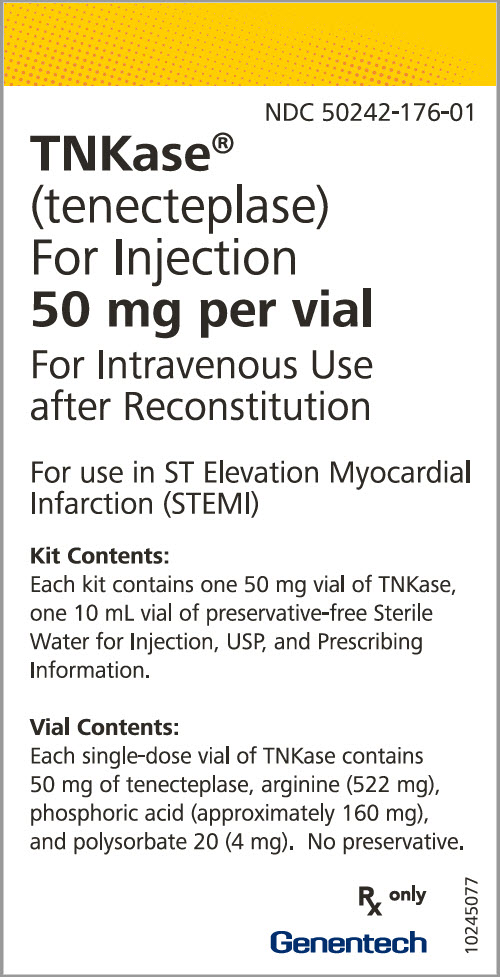
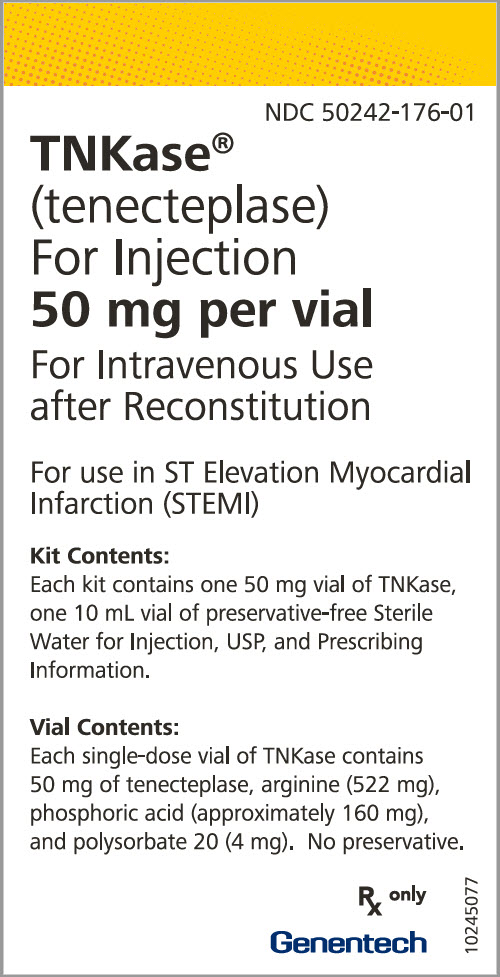
- PRINCIPAL DISPLAY PANEL - Kit Carton - 50 mg
- PRINCIPAL DISPLAY PANEL - Kit Carton - 25 mg
-
INGREDIENTS AND APPEARANCE
TNKASE
tenecteplase kitProduct Information Product Type HUMAN PRESCRIPTION DRUG Item Code (Source) NDC:50242-176 Packaging # Item Code Package Description Marketing Start Date Marketing End Date 1 NDC:50242-176-01 1 in 1 CARTON 01/05/2024 Quantity of Parts Part # Package Quantity Total Product Quantity Part 1 1 VIAL, SINGLE-USE 10 mL Part 2 1 VIAL, SINGLE-USE 10 mL Part 1 of 2 TNKASE
tenecteplase injection, powder, lyophilized, for solutionProduct Information Item Code (Source) NDC:50242-037 Route of Administration INTRAVENOUS Active Ingredient/Active Moiety Ingredient Name Basis of Strength Strength TENECTEPLASE (UNII: WGD229O42W) (TENECTEPLASE - UNII:WGD229O42W) TENECTEPLASE 50 mg in 10 mL Inactive Ingredients Ingredient Name Strength ARGININE (UNII: 94ZLA3W45F) PHOSPHORIC ACID (UNII: E4GA8884NN) POLYSORBATE 20 (UNII: 7T1F30V5YH) Packaging # Item Code Package Description Marketing Start Date Marketing End Date 1 NDC:50242-037-06 1 in 1 CARTON 1 10 mL in 1 VIAL, SINGLE-USE; Type 1: Convenience Kit of Co-Package Marketing Information Marketing Category Application Number or Monograph Citation Marketing Start Date Marketing End Date BLA BLA103909 01/05/2024 Part 2 of 2 STERILE WATER
sterile water injection, solutionProduct Information Item Code (Source) NDC:50242-901 Route of Administration INTRAVENOUS Inactive Ingredients Ingredient Name Strength WATER (UNII: 059QF0KO0R) 10 mL in 10 mL Packaging # Item Code Package Description Marketing Start Date Marketing End Date 1 NDC:50242-901-09 1 in 1 CARTON 1 10 mL in 1 VIAL, SINGLE-USE; Type 1: Convenience Kit of Co-Package Marketing Information Marketing Category Application Number or Monograph Citation Marketing Start Date Marketing End Date BLA BLA103909 01/05/2024 Marketing Information Marketing Category Application Number or Monograph Citation Marketing Start Date Marketing End Date BLA BLA103909 01/05/2024 TNKASE
tenecteplase kitProduct Information Product Type HUMAN PRESCRIPTION DRUG Item Code (Source) NDC:50242-014 Packaging # Item Code Package Description Marketing Start Date Marketing End Date 1 NDC:50242-014-03 1 in 1 CARTON 02/28/2025 Quantity of Parts Part # Package Quantity Total Product Quantity Part 1 1 VIAL, SINGLE-USE 5 mL Part 2 1 VIAL, SINGLE-USE 5.2 mL Part 1 of 2 TNKASE
tenecteplase injection, powder, lyophilized, for solutionProduct Information Item Code (Source) NDC:50242-009 Route of Administration INTRAVENOUS Active Ingredient/Active Moiety Ingredient Name Basis of Strength Strength TENECTEPLASE (UNII: WGD229O42W) (TENECTEPLASE - UNII:WGD229O42W) TENECTEPLASE 25 mg in 5 mL Inactive Ingredients Ingredient Name Strength ARGININE (UNII: 94ZLA3W45F) PHOSPHORIC ACID (UNII: E4GA8884NN) POLYSORBATE 20 (UNII: 7T1F30V5YH) Packaging # Item Code Package Description Marketing Start Date Marketing End Date 1 NDC:50242-009-01 1 in 1 CARTON 1 5 mL in 1 VIAL, SINGLE-USE; Type 1: Convenience Kit of Co-Package Marketing Information Marketing Category Application Number or Monograph Citation Marketing Start Date Marketing End Date BLA BLA103909 02/28/2025 Part 2 of 2 STERILE WATER
sterile water injection, solutionProduct Information Item Code (Source) NDC:50242-907 Route of Administration INTRAVENOUS Inactive Ingredients Ingredient Name Strength WATER (UNII: 059QF0KO0R) 5.2 mL in 5.2 mL Packaging # Item Code Package Description Marketing Start Date Marketing End Date 1 NDC:50242-907-01 1 in 1 CARTON 1 5.2 mL in 1 VIAL, SINGLE-USE; Type 1: Convenience Kit of Co-Package Marketing Information Marketing Category Application Number or Monograph Citation Marketing Start Date Marketing End Date BLA BLA103909 02/28/2025 Marketing Information Marketing Category Application Number or Monograph Citation Marketing Start Date Marketing End Date BLA BLA103909 02/28/2025 Labeler - Genentech, Inc. (080129000) Registrant - Genentech, Inc. (080129000) Establishment Name Address ID/FEI Business Operations Genentech, Inc. 080129000 ANALYSIS(50242-014, 50242-176) , MANUFACTURE(50242-014, 50242-176) , API MANUFACTURE(50242-014, 50242-176) , PACK(50242-014, 50242-176) , LABEL(50242-014, 50242-176) Establishment Name Address ID/FEI Business Operations Genentech, Inc. (Hillsboro) 833220176 LABEL(50242-014, 50242-176) , PACK(50242-014, 50242-176) , ANALYSIS(50242-014, 50242-176) Establishment Name Address ID/FEI Business Operations Genentech, Inc. (Oceanside) 146373191 ANALYSIS(50242-014, 50242-176)