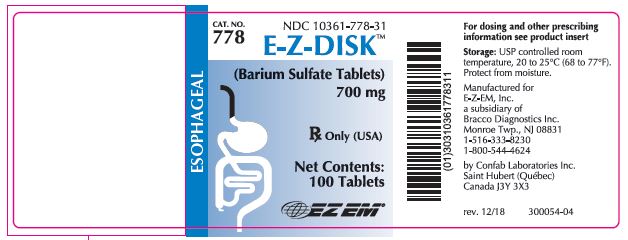
Label: E-Z-DISK- barium sulfate tablet
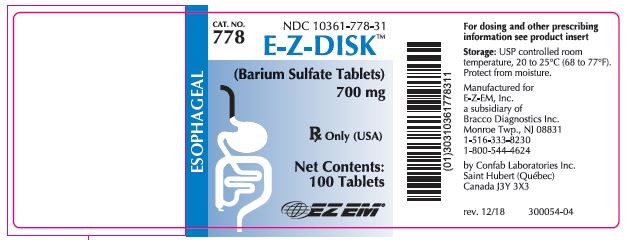
- NDC Code(s): 10361-778-31
- Packager: E-Z-EM, INC.
- Category: HUMAN PRESCRIPTION DRUG LABEL
- DEA Schedule: None
- Marketing Status: unapproved drug other
DISCLAIMER: This drug has not been found by FDA to be safe and effective, and this labeling has not been approved by FDA. For further information about unapproved drugs, click here.
Drug Label Information
Updated November 28, 2023
If you are a consumer or patient please visit this version.
- Download DRUG LABEL INFO: PDF XML
- Official Label (Printer Friendly)
-
DESCRIPTION
E-Z-DISK™ is an oral solid radiographic contrast agent. Each tablet contains 700 mg of barium sulfate and is ½ inch in diameter. The active ingredient is barium sulfate and its structural formula is BaSO4. Barium sulfate occurs as a fine, white, odorless, tasteless, bulky powder which is free from grittiness. Its aqueous suspensions are neutral to litmus. It is practically insoluble in water, solutions of acids and alkalies, and organic solvents.
- INDICATIONS AND USAGE
-
CLINICAL
PHARMACOLOGY
Barium sulfate, due to its high molecular density is opaque to x-rays and therefore acts as a positive contrast agent for radiographic studies. Barium sulfate is biologically inert and therefore is not absorbed or metabolized by the body, and is eliminated unchanged from the body.
Absorption and Metabolism
E-Z-DISK tablets disintegrate within 30 minutes after ingestion, and the fragments are eliminated with the feces without absorption of the barium sulfate. A brief delay in transit may sometimes be seen in elderly patients, particularly above the hiatus, or at the level of the aortic arch. In such instances, a sip of water is sufficient to carry the tablet down the esophagus.
- CONTRAINDICATIONS
-
WARNINGS
Rarely, severe allergic reactions of an anaphylactoid nature have been reported following administration of barium sulfate contrast agents. Appropriate facilities and trained personnel should be available for emergency treatment of severe reactions and should remain available for at least 30 to 60 minutes following administration, since delayed reactions can occur.
-
PRECAUTIONS
General
Diagnostic procedures which involve the use of radiopaque contrast agents should be carried out under the direction of personnel with the requisite training and with a thorough knowledge of the particular procedure to be performed. A history of bronchial asthma, atopy, as evidenced by hay fever and eczema, or a previous reaction to a contrast agent, warrant special attention.
Use with caution in patients with complete or nearly complete esophageal or gastric obstruction.
Information For Patients
Before administration of this product, patients receiving barium sulfate diagnostic agents should be instructed to:
- Inform their physician if they are pregnant.
- Inform their physician if they are allergic to any drugs or food, or if they have had any prior reactions to barium sulfate products or other contrast agents used in x-ray procedures (see PRECAUTIONS-General).
- Inform their physician about any other medications they are currently taking.
-
ADVERSE
REACTIONS
Adverse reactions, such as nausea, vomiting, diarrhea and abdominal cramping accompanying the use of barium sulfate suspensions are infrequent, usually mild, and generally do not occur with this product. Procedural complications are rare, but may include aspiration pneumonitis, granuloma formation, intravasation, embolization and peritonitis following intestinal perforation, vasovagal and syncopal episodes, and fatalities. It is of the utmost importance to be completely prepared to treat any such occurrence.
-
ALLERGIC REACTIONS
Due to the increased likelihood of allergic reactions in atopic patients, it is important that a complete history of known and suspected allergies as well as allergic-like symptoms, e.g., rhinitis, bronchial asthma, eczema and urticaria, be obtained prior to any medical procedure utilizing these products. A mild allergic reaction would most likely include generalized pruritus, erythema or urticaria. Such reactions will generally respond to an antihistamine such as 50 mg of diphenhydramine, or its equivalent. In the rarer, more serious reactions, laryngeal edema, bronchospasm or hypotension could develop. Severe reactions which may require emergency measures are often characterized by peripheral vasodilation, hypotension, reflex tachycardia, dyspnea, agitation, confusion and cyanosis progressing to unconsciousness. Treatment should be initiated immediately with 0.3 to 0.5 mL of 1:1000 epinephrine subcutaneously. If bronchospasm predominates, 0.25 to 0.50 grams of intravenous aminophylline should be given slowly. Appropriate vasopressors might be required. Adrenocorticosteroids, even if given intravenously, exert no significant effect on the acute allergic reactions for a few hours. The administration of these agents should not be regarded as emergency measures for the treatment of allergic reactions. All levels of allergic reactions are extremely rare with this product. Apprehensive patients may develop weakness, pallor, tinnitus, diaphoresis and bradycardia following the administration of any diagnostic agent. Such reactions are usually non-allergic in nature and are best treated by having the patient lie flat for an additional 10 to 30 minutes under observation.
-
DOSAGE
AND ADMINISTRATION
This tablet is most useful in patients experiencing dysphagia, particularly in those whose findings are deemed inconclusive by conventional methods. The problems associated with obtaining satisfactory films exhibiting complete filling of the pharynx and cricopharyngeal area make for difficult diagnosis in this region. In such cases, failure of the tablet to freely pass this site may indicate significant esophageal disease as cause of the symptoms, and may warrant further videographic studies.
The patient should be instructed to swallow one tablet intact, with the aid of one or two swallows of water, just prior to fluoroscopic examination.
Note: Using a tablet of known diameter (½ inch) not only illustrates the presence of a significant narrowing of the esophagus, but also provides a simple technique to measure the lumen at the site of the stricture. The most routinely used esophagoscope has external diameter of 36 French, and thus a tablet of corresponding half-inch diameter was selected. The actual diameter (in inches) of the narrow site is one-half the ratio of its measure value on the film to the measure of the tabletUpon swallowing the tablet, the patient experiences no significant discomfort, and fluid passes around the tablet without difficulty.
- HOW SUPPLIED
- SPL UNCLASSIFIED SECTION
- PRINCIPAL DISPLAY PANEL
-
INGREDIENTS AND APPEARANCE
E-Z-DISK
barium sulfate tabletProduct Information Product Type HUMAN PRESCRIPTION DRUG Item Code (Source) NDC:10361-778 Route of Administration ORAL Active Ingredient/Active Moiety Ingredient Name Basis of Strength Strength BARIUM SULFATE (UNII: 25BB7EKE2E) (BARIUM SULFATE - UNII:25BB7EKE2E) BARIUM SULFATE 700 mg Product Characteristics Color WHITE Score no score Shape ROUND (ROUND, FLAT) Size 13mm Flavor Imprint Code 778;EZEM Contains Packaging # Item Code Package Description Marketing Start Date Marketing End Date 1 NDC:10361-778-31 100 in 1 BOTTLE, GLASS; Type 0: Not a Combination Product 02/01/2009 Marketing Information Marketing Category Application Number or Monograph Citation Marketing Start Date Marketing End Date Unapproved drug other 02/01/2009 Labeler - E-Z-EM, INC. (002041226) Registrant - E-Z-EM, INC. (002041226) Establishment Name Address ID/FEI Business Operations Confab Laboratories Inc 241754217 MANUFACTURE(10361-778) , LABEL(10361-778) , PACK(10361-778) , ANALYSIS(10361-778) Establishment Name Address ID/FEI Business Operations E-Z-EM Canada Inc 204211163 ANALYSIS(10361-778)